
Off the Beaten Path
Any time I hear the words “field trip,” memories of my own middle school excursions pop into my mind. All these years later, I can still remember that distinct smell of school bus diesel and eating lunch on a museum lawn. It’s natural that we want our own students to experience the same freedom that comes from learning off campus.
However, we are living in a much different economic environment than when we were students. As principals, it’s incumbent on us to question if our budgets—already stretched to the max—can handle the additional burden.
Transportation Costs
There is no doubt our academic years are already chock full. We have instructional standards, state testing, and bulging curricula. When it comes to field trips, a light is being shone across all of K–12 to ensure they are aligned to curriculum and standards.
Field trips also place significant burdens on our teachers. On top of everything else, we are adding the task of “bookkeeper” to their piles. A field trip necessitates permission slips, parent volunteers, and a tally of who has paid and who hasn’t. With all teachers must already fit into a day, emailing and calling parents is an extra task that takes several hours outside of the school day.
Additionally, removing a calendar day means a lesson may be missed. A club meeting may have to be postponed. Another teacher will have to be asked to cover lunch duty.
But hands down, the biggest obstacle to field trips today is budget. I recently had a “free admission” field trip that cost a thousand dollars. Most of that was not due to the field trip itself, but because of transportation.
With skyrocketing fuel costs, reserving a bus for the day and the driver’s salary for the time they are driving and waiting for the children, field trips are no longer a “buckle up and let’s go” kind of situation.
The Cost to Parents
The real challenge of a field trip is that it’s a pass-through cost. The funding I receive is earmarked for teacher salaries, curriculum materials, copy paper, and custodial supplies. Above and beyond state funding, some schools can supplement field trips with PTA or PTO funds. Maybe some districts have arts grants that can help defray costs. But for the most part, I’m passing on field trip costs to families.
I don’t work in a low-income school district, but if you look at a field trip for 75 kids that costs $1,000, the pass-through cost is almost $15 per child. Sure, that isn’t crazy, but most parents have more than one child. They are buying clothing and school supplies and sports equipment. They have dental and medical bills and childcare costs. Everything is more expensive these days, which means we really must be discerning about the costs we pass on to our families.
I am lucky that in my district, most families can afford to pay for most pass-through costs. But as principals, we must be vigilant about our families entitled to assistance. They have been promised a free public education. Is it then fair to ask them to pay $15 for their child to have an educational experience? Even for families that we assume can cover basic costs, how much can we keep asking of them? We don’t know what many families are dealing with, and those constant $15 asks can add up.
As principals, we are constantly facing the push-pull between the breaking point and what is still somewhat sustainable. Given that the simple, nostalgic field trip may be a thing of the past, how do we still create unique out-of-school learning opportunities for our students that can be handled within budget?
The Value of Disruption
In the tech world, “disruptors” are innovations that have value because they serve a market that established companies tend to ignore. Field trips are the educational equivalent of a “disruptor.” We are all aware of the benefit of stepping outside of our daily routines to gain a new perspective—whether it’s sitting under a planetarium dome and learning about our solar system or having a conversation that may not happen unless the school day was otherwise jostled.
I could be remembering incorrectly, but field trips in the past had an element, of let’s just pick up and go. It’s much different today, and we need to make a much bigger case for the value of disruptors in education.
With all we need to accomplish in a school year to prepare our students for the grade ahead, it can be difficult to justify the time, the planning, and the expense field trips require. However, I’m here to fight the good fight. Below are some creative strategies I’ve adopted to ensure our students have enriching experiences beyond the classroom.
Creative Solutions
I love that my first graders go to the pumpkin patch every October. What can be a better community-bonding event? They head out on the hayrides and come back with their pumpkins and huge smiles on their faces. What could be better?
And yet, show me in the curriculum where that is a learning experience. In some districts, the curriculum is the number one thing, and if you can’t show how this field trip is aligned to the learning standard, then it must go.
“When it comes to understanding the night sky or experiencing a tornado in a tunnel, it’s becoming easier to bring those experiences in-house for the entire school.”
To that I would say that curriculum is always the priority, but isn’t life also about the fullness of an experience? The time away from the desk. The learning that happens informally. The measure of what we can gain from an unexpected conversation.
So, we have a bit of a challenge across the continuum. How can we capture our students’ hearts and imaginations and keep the experience within budget?
In my district, I’m going to fight to keep those “legacy” field trips that may not adhere to a lesson plan but still provide meaningful experiences.
Sometimes it comes down to creative fundraising. My sixth graders have their own tradition of a three-day Outdoor Education experience. Again, while it can’t be justified by the curriculum, I’m a strong proponent of this field trip because of the genuine bonds it forges. At this age, when kids are in transition, healthy relationships with their peers can be grounding—and ultimately helpful to classroom management for my teachers.
Because this trip came out to about $275 per student, we fundraised dollars to offset the cost by organizing a pancake breakfast. It was a schoolwide fundraiser, and a wonderful community event. Yes, it was a lot of work for all of us, but I like to think the benefit of deepening our relationships with families was worth the effort.
Bringing the Field Trip to You
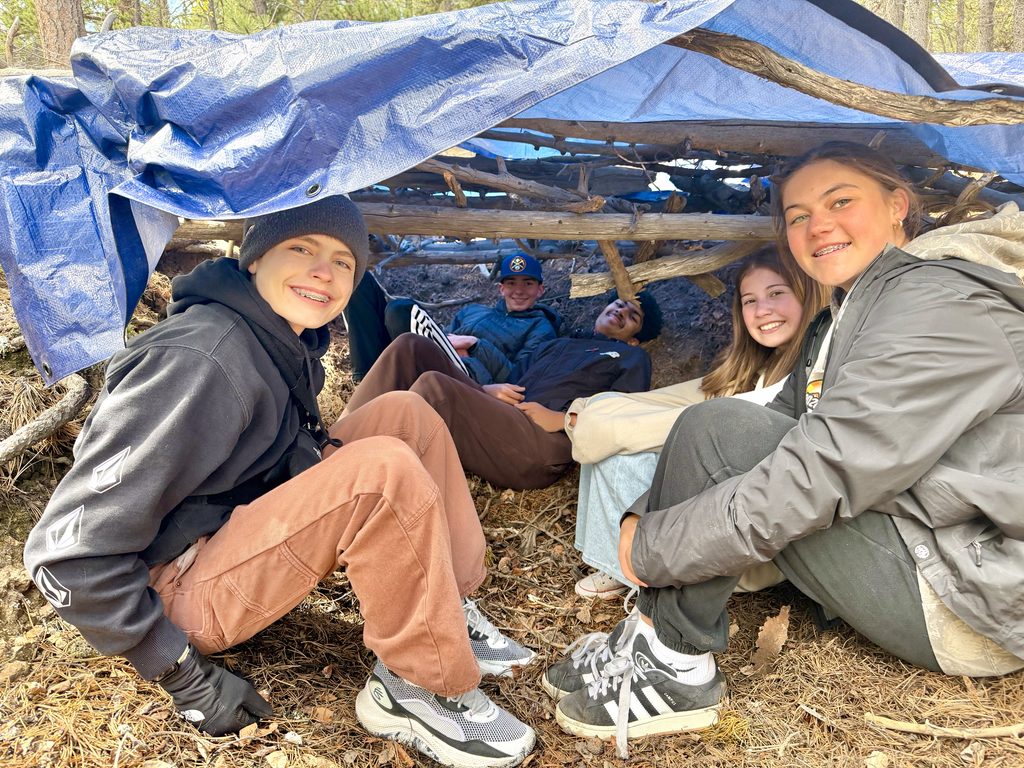
Students on the trip build a shelter.
What is it that makes a field trip special? Is it about picking up the snake or having a bird land on your wrist? In many cases, we can bring those experiences into our schools and eliminate much of the transportation costs. When it comes to understanding the night sky or experiencing a tornado in a tunnel, it’s becoming easier to bring those experiences in-house for the entire school.
Mobile planetariums, reptile and animal encounters, mobile science labs, and tide pool and touch-tank programs are available in most urban environments. While students remain in school, the novelty of the experience and time away from the desk provide an engaging opportunity that can enhance life-science curricula and provide a fun day students look forward to.
For the last few years, walking field trips have been gamechangers for us. From our campus, our seventh graders can do a walking tour to an open space about a mile away. They study the habitat of the open space, enjoy a half-day away from school, and share the experience with classmates. Our cafeteria provides bag lunches, and our students can have that offsite experience without the transportation costs.
Redefining What Works
If you are like me and you don’t want to relegate field trips to the closet of nostalgia, the question we need to ask ourselves is this: How can we redefine them so that they are more affordable and make sense for today’s curriculum?
What can we do that’s cool, fun, affordable, easy to access, developmentally appropriate, and a learning opportunity? Luckily, these amazing experiences don’t always call for a yellow bus.
Nicholas Vanderpol is the principal of Eldorado PK–8 School in Boulder, CO.